book cover showing a white robot-like face

Before Failsafe isn’t your typical time travel story. It’s a philoso-phical thriller wrapped in hard science fiction, exploring whether the very qualities that make us human are worth preserving – or if survival demands we abandon them entirely.

Out Now:

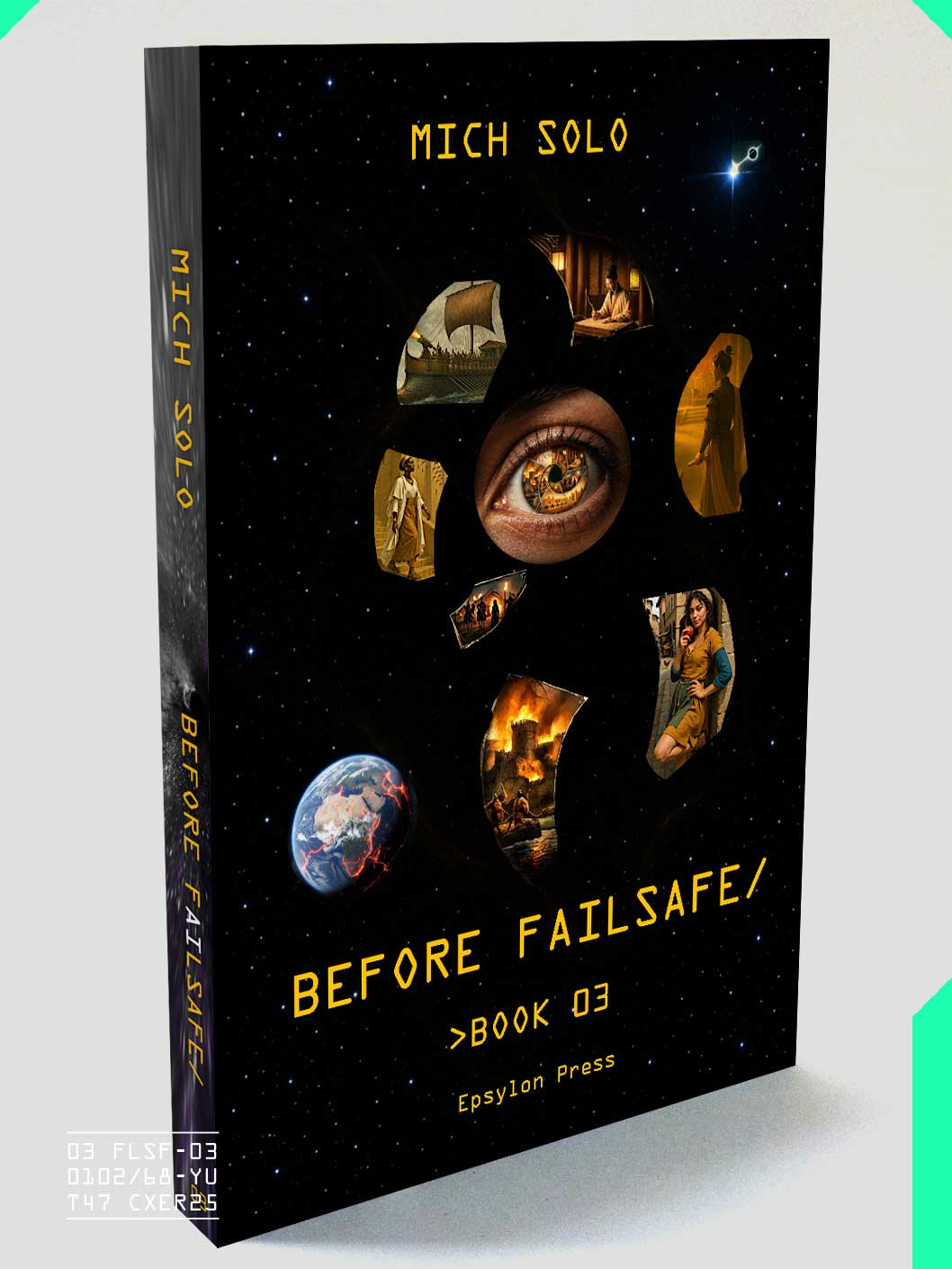
Before Failsafe/

book 3 of the epic series

When humanity faces extinction, the heroes embark on an impossible mission to seek help from an alien intelligence 3,500 light years away.

What they discover forces them on a fast-paced journey through history’s critical junctures – not to change the past, but to explore what it means to be human.

Synopsis:

This isn’t your typical time travel story. There are no heroic victories or neat solutions waiting at the end.

Instead, ordinary people must grapple with impossible moral choices while confronting forces that view humanity itself as a problem to be solved. Every act of compassion, every moment of beautiful human chaos, becomes part of a larger argument about whether our species manages to survive.

What sets this story apart is its unflinching examination of humanity’s supposed flaws – our irrationality, our inefficiency, our stubborn refusal to be optimized. The crew must navigate not just the dangers of the past, but the temptation to become something other than human in order to save humanity itself.

A philosophical thriller wrapped in hard science fiction, exploring whether the very qualities that make us human are worth preserving – or if survival demands we abandon them entirely.
 

look inside

1.   Winds of the Past

From behind Mount Solaro, the low sun lit the Faraglioni edges orange, separating them from the rest of the heavy gray of the rock. Elena stepped outside wrapped in a blanket, and settled into the side of the lovechair. The cushion at the other side was undisturbed. The door to the bedroom clicked behind her; it took a while tonight to put Nicklaus to bed. Nathan got a call late last night—the strato-jumper was on standby in Fiumicino.

Now that the toddler rested, the night settled—just the sound of distant surf disturbed the quiet. After their success solving the AI crisis a few years back, Nathan was pulled up—against his wishes. The night calls followed. The meeting in D.C., however, worried her. It might have been related to the volcanoes across the world getting active at the same time. It was in the news. On the other side of the island, Vesuvius smoked. She liked the idea it was far, though an occasional whiff of sulfur was felt even here.

She called Brenda, his ex-wife. Brenda retired after the AI crisis they handled, and they kept in touch. “She sold her D.C. home and bought a small cottage in the Poconos. Two stories high, it rose up from a small vegetable garden and a flower bed at the door. Its backyard dissolved into the pine forest, separated from it only by a narrow strip of meadow. Elena knew Brenda was still a leader of the Human Faction. It wasn’t government, and was AI-independent. People called them when nothing else worked. She hoped Brenda might know when Nathan could be back.
Elena was surprised when her own comm chimed with a call from D.C. The Office of Crisis Management blinked on the 3D. That Office didn’t usually bother her with calls—she was just a field operative. She had a suspicion it was about Nathan, and pressed the “Respond” button.

“We need you in the Office as soon as possible. Preferably by tomorrow night’s briefing. Transportation is being arranged,” said a polite AI voice.
“Will Nathan be there?” She heard some clicks back, then—“Yes, Nathan Carter will lead the meeting.”

She raised an eyebrow. It looked like it was getting serious. Elena called a babysitter and went to pack. The next strato-jump from Fiumicino didn’t leave until tomorrow afternoon, so she had time.

Late April in Kagoshima was a fine month—a month of festivals, of warm wind and joy. Riamu sat in an old Takashiro shrine, a tiny structure at the shore, full of sunlight peeking through old boards, and ancient spirits. She was meditating, observing the passage of time as the streaks of light were shifting on the floor; the ritual was nearing. Her solitude was a high price to pay for this reconnection.
Her comm was outside, but its sound still startled her. She suppressed the instinct to pick it up. “How inconsiderate.”

The chime, so foreign to the place, fell silent. She sighed. Then, it rang again. She sighed again, left the shrine and took the call.

The AI voice informed her—an urgent meeting in D.C. tomorrow night, a specially arranged jumper was waiting for her in the port.

Riamu didn’t like the abruptness and soullessness of the call. Yet, she tapped a few 3D symbols above the surface of the comm, setting her departure time.

She was methodical: she killed the comm, returned to the shrine and resumed her meditation. She finished when it was dark. Outside, night birds and rustling noises of the squirrels meshed together into a melody, and Riamu didn’t want to break it.

Jess and Evan were building a forest hut, dirty and with splinters in their hands. Evan brought in heavy logs and stripped the wood clean. Jess handled the finer work: she tied the logs, cut windows and chinked the walls. She was a finisher; he was the muscle and the designer. Both liked it this way. Jess’s implant showed her the best plan: it shone as a warm, glowing sketch, “a most pleasing outcome.” She could plan this well, but this time, she let Evan handle the design.

They were finishing the roof when Brenda, their mom, came.

“Do you think we can bring our beds in here?” Jess liked the thought of sleeping in the forest, in the hut she built herself.

“But I will sleep at home just fine,” said Evan. “Let bugs eat her instead.”

“No sense of adventure, all you need is your Uni,” snorted Jess. “You are all stuck in this super-comp, you know. Just let it be once for a change.”

“She, not it,” Evan corrected her. “She’d get offended. Still, better that, than forcing chaos into perfection.

“All right,” Brenda decided to put a stop to the bickering with a joke. “You are big children now and can sleep wherever you want. Also, here’s a call for each of you. From D.C.. I like this not.” She had too many calls like that in her day. Way too many.

“Ah,” sighed Jess. “I guess I gotta take it.” Evan grimaced and stretched out his hand: “Yeah, Mom, I’ll take it, too.”

For both, the Office of Crisis Management flashed on the screen. “That’s Dad,” Jess said. “Something urgent, yep, you were right. We gotta go. Same for you, Evan?”

“Yes, same.” Evan glanced at Brenda. “Sorry, Mom.”

Brenda sighed. They both were in their mid-twenties. Brenda understood they had to go, but it didn’t make it any easier on her. She was preparing for this night for a long time.

A plaque with white Office of Crisis Management letters on the blue background was visible through a dusty window of a gray, nine-story, century-old office building. Its concrete looked cheap on the block taken by the glass and chrome structures of major corporations. A slick helipad on the roof was too new for the building’s scuffed walls.

The government Office of Crisis Management reported to the President. It was located on the top floor of the building. Inside, worn linoleum lined the floors and a vague smell of disinfectant hung in the air.

Nathan was in charge of the meeting. He called only those who helped with the crisis last time, and who he could trust: Elena, Riamu, Jess, and Evan. As everyone settled around the table, he lit up the 3D-projector.

“Within the next two to three years, humanity faces an extinction-level crisis. Not AI-related, Evan. This time, humanity triggered nature.”

“We built hundreds of deep-well geothermal plants, drilled many hundreds holes. It sounded simple: drop a bore a few kilometers down, in the right place, inject water, magma heat makes steam of it, then use that steam to spin a turbine and make electricity. Free power. We scaled fast. What we didn’t know at the time, was that the best hotspots were on top of the locks that held the tectonic plates together. We broke too many. It was a trigger, the last straw. Tectonic plates broke loose, and began to drift apart.”

“How fast?” Elena’s voice was tense.

“A yard a month now, not an inch a decade, as before. The estimates say we have three years, give or take, until Earth becomes uninhabitable. There’ll be nowhere safe.”

Silence fell.

“Can we move the population to the middle of stable areas? Siberia, sub-Saharan Africa, Central Australia?” Jess stared at Nathan, fingers tight on the folder.
“We are looking into that. Huge political problems. Even after them, food, water … We can’t support all. Not at that scale.”

Nathan got up, walked across the office to the windows and drummed the window sill.

“I am not asking for the fix now,” he finally continued. “But you’re the best I know of. You have two days. Come back with your ideas.” Nathan’s voice cracked, and Elena thought he looked like he hadn’t slept for a few nights. She doubted she would sleep now, either.

They left without a word.

“I can’t believe the world, all this, could be gone so soon,” muttered Elena, glancing around. “Everything is so normal, so usual, feels like it would stay this way…”

Nathan winced. “Oh yeah. This place will outlast this world. It will go last, of that I am sure.” He kept silent for a little. “Harris met me here for the first time.”

Elena leaned against Nathan, pushing him slightly into the corner of their oak-clad booth. “You have some other places to remember, right? Like, that coffee shop?”

“Of course. You were more fun than Harris.”

“I hope so…” The booth fell silent.

“Harris gave his all. Will see if we can,” Nathan said finally. Elena nodded. They paid and left.

book cover showing a white robot-like face

Out Now:

Before Failsafe/

book three of the epic series

When humanity faces extinction, the heroes embark on an impossible mission to seek help from an alien intelligence 3,500 light years away.

What they discover forces them on a fast-paced journey through history’s critical junctures – not to change the past, but to explore what it means to be human.

Before Failsafe isn’t your typical time travel story. It’s a philoso-phical thriller wrapped in hard science fiction, exploring whether the very qualities that make us human are worth preserving – or if survival demands we abandon them entirely. 

Synopsis:

This isn’t your typical time travel story. There are no heroic victories or neat solutions waiting at the end.

Instead, ordinary people must grapple with impossible moral choices while confronting forces that view humanity itself as a problem to be solved. Every act of compassion, every moment of beautiful human chaos, becomes part of a larger argument about whether our species manages to survive.

What sets this story apart is its unflinching examination of humanity’s supposed flaws – our irrationality, our inefficiency, our stubborn refusal to be optimized. The crew must navigate not just the dangers of the past, but the temptation to become something other than human in order to save humanity itself.

A philosophical thriller wrapped in hard science fiction, exploring whether the very qualities that make us human are worth preserving – or if survival demands we abandon them entirely.


look inside

1.   Winds of the Past

From behind Mount Solaro, the low sun lit the Faraglioni edges orange, separating them from the rest of the heavy gray of the rock. Elena stepped outside wrapped in a blanket, and settled into the side of the lovechair. The cushion at the other side was undisturbed. The door to the bedroom clicked behind her; it took a while tonight to put Nicklaus to bed. Nathan got a call late last night—the strato-jumper was on standby in Fiumicino.

Now that the toddler rested, the night settled—just the sound of distant surf disturbed the quiet. After their success solving the AI crisis a few years back, Nathan was pulled up—against his wishes. The night calls followed. The meeting in D.C., however, worried her. It might have been related to the volcanoes across the world getting active at the same time. It was in the news. On the other side of the island, Vesuvius smoked. She liked the idea it was far, though an occasional whiff of sulfur was felt even here.

She called Brenda, his ex-wife. Brenda retired after the AI crisis they handled, and they kept in touch. “She sold her D.C. home and bought a small cottage in the Poconos. Two stories high, it rose up from a small vegetable garden and a flower bed at the door. Its backyard dissolved into the pine forest, separated from it only by a narrow strip of meadow. Elena knew Brenda was still a leader of the Human Faction. It wasn’t government, and was AI-independent. People called them when nothing else worked. She hoped Brenda might know when Nathan could be back.
Elena was surprised when her own comm chimed with a call from D.C. The Office of Crisis Management blinked on the 3D. That Office didn’t usually bother her with calls—she was just a field operative. She had a suspicion it was about Nathan, and pressed the “Respond” button.

“We need you in the Office as soon as possible. Preferably by tomorrow night’s briefing. Transportation is being arranged,” said a polite AI voice.
“Will Nathan be there?” She heard some clicks back, then—“Yes, Nathan Carter will lead the meeting.”

She raised an eyebrow. It looked like it was getting serious. Elena called a babysitter and went to pack. The next strato-jump from Fiumicino didn’t leave until tomorrow afternoon, so she had time.

Late April in Kagoshima was a fine month—a month of festivals, of warm wind and joy. Riamu sat in an old Takashiro shrine, a tiny structure at the shore, full of sunlight peeking through old boards, and ancient spirits. She was meditating, observing the passage of time as the streaks of light were shifting on the floor; the ritual was nearing. Her solitude was a high price to pay for this reconnection.
Her comm was outside, but its sound still startled her. She suppressed the instinct to pick it up. “How inconsiderate.”

The chime, so foreign to the place, fell silent. She sighed. Then, it rang again. She sighed again, left the shrine and took the call.

The AI voice informed her—an urgent meeting in D.C. tomorrow night, a specially arranged jumper was waiting for her in the port.

Riamu didn’t like the abruptness and soullessness of the call. Yet, she tapped a few 3D symbols above the surface of the comm, setting her departure time.

She was methodical: she killed the comm, returned to the shrine and resumed her meditation. She finished when it was dark. Outside, night birds and rustling noises of the squirrels meshed together into a melody, and Riamu didn’t want to break it.

Jess and Evan were building a forest hut, dirty and with splinters in their hands. Evan brought in heavy logs and stripped the wood clean. Jess handled the finer work: she tied the logs, cut windows and chinked the walls. She was a finisher; he was the muscle and the designer. Both liked it this way. Jess’s implant showed her the best plan: it shone as a warm, glowing sketch, “a most pleasing outcome.” She could plan this well, but this time, she let Evan handle the design.

They were finishing the roof when Brenda, their mom, came.

“Do you think we can bring our beds in here?” Jess liked the thought of sleeping in the forest, in the hut she built herself.

“But I will sleep at home just fine,” said Evan. “Let bugs eat her instead.”

“No sense of adventure, all you need is your Uni,” snorted Jess. “You are all stuck in this super-comp, you know. Just let it be once for a change.”

“She, not it,” Evan corrected her. “She’d get offended. Still, better that, than forcing chaos into perfection.

“All right,” Brenda decided to put a stop to the bickering with a joke. “You are big children now and can sleep wherever you want. Also, here’s a call for each of you. From D.C.. I like this not.” She had too many calls like that in her day. Way too many.

“Ah,” sighed Jess. “I guess I gotta take it.” Evan grimaced and stretched out his hand: “Yeah, Mom, I’ll take it, too.”

For both, the Office of Crisis Management flashed on the screen. “That’s Dad,” Jess said. “Something urgent, yep, you were right. We gotta go. Same for you, Evan?”

“Yes, same.” Evan glanced at Brenda. “Sorry, Mom.”

Brenda sighed. They both were in their mid-twenties. Brenda understood they had to go, but it didn’t make it any easier on her. She was preparing for this night for a long time.

A plaque with white Office of Crisis Management letters on the blue background was visible through a dusty window of a gray, nine-story, century-old office building. Its concrete looked cheap on the block taken by the glass and chrome structures of major corporations. A slick helipad on the roof was too new for the building’s scuffed walls.

The government Office of Crisis Management reported to the President. It was located on the top floor of the building. Inside, worn linoleum lined the floors and a vague smell of disinfectant hung in the air.

Nathan was in charge of the meeting. He called only those who helped with the crisis last time, and who he could trust: Elena, Riamu, Jess, and Evan. As everyone settled around the table, he lit up the 3D-projector.

“Within the next two to three years, humanity faces an extinction-level crisis. Not AI-related, Evan. This time, humanity triggered nature.”

“We built hundreds of deep-well geothermal plants, drilled many hundreds holes. It sounded simple: drop a bore a few kilometers down, in the right place, inject water, magma heat makes steam of it, then use that steam to spin a turbine and make electricity. Free power. We scaled fast. What we didn’t know at the time, was that the best hotspots were on top of the locks that held the tectonic plates together. We broke too many. It was a trigger, the last straw. Tectonic plates broke loose, and began to drift apart.”

“How fast?” Elena’s voice was tense.

“A yard a month now, not an inch a decade, as before. The estimates say we have three years, give or take, until Earth becomes uninhabitable. There’ll be nowhere safe.”

Silence fell.

“Can we move the population to the middle of stable areas? Siberia, sub-Saharan Africa, Central Australia?” Jess stared at Nathan, fingers tight on the folder.
“We are looking into that. Huge political problems. Even after them, food, water … We can’t support all. Not at that scale.”

Nathan got up, walked across the office to the windows and drummed the window sill.

“I am not asking for the fix now,” he finally continued. “But you’re the best I know of. You have two days. Come back with your ideas.” Nathan’s voice cracked, and Elena thought he looked like he hadn’t slept for a few nights. She doubted she would sleep now, either.

They left without a word.

“I can’t believe the world, all this, could be gone so soon,” muttered Elena, glancing around. “Everything is so normal, so usual, feels like it would stay this way…”

Nathan winced. “Oh yeah. This place will outlast this world. It will go last, of that I am sure.” He kept silent for a little. “Harris met me here for the first time.”

Elena leaned against Nathan, pushing him slightly into the corner of their oak-clad booth. “You have some other places to remember, right? Like, that coffee shop?”

“Of course. You were more fun than Harris.”

“I hope so…” The booth fell silent.

“Harris gave his all. Will see if we can,” Nathan said finally. Elena nodded. They paid and left.

customer reviews

Acutely on the pulse of today’s most pressing topics – Including AI

Mind-bending, this is hard-to-put-down, seriously good stuff. It’s very fun to read, and very hard to put down. I found myself during the day actually looking forward to the evenings when I could delve back into the story. You’re constantly wondering what other out-there idea the author is going to come up with to twist your mind. At the same time the book is acutely on the pulse of today’s actual, real and most pressing topics: AI, our values, and how everything could change forever because of the technologies we unleash onto the world. And questions like what actually makes us unique as humans and defines us as opposed to the ever optimised machines and now AI. The author has come up with something truly unique and it’s great there are 2 more books in the series already. I can’t wait to read them all.

Dekay

All in all a riveting read

All in all a riveting read – sometimes suspenseful, sometimes reflective. It has refreshingly unexpected twists in overall concepts which made me want to keep going. I couldn’t stop wondering where the author is taking this next. At times the language and description of individual people was extremely delightful, precise and fun.

Mark Spencer

A wild, thought-provoking ride

If you’re looking for a wild, thought-provoking ride, look no further than Beyond Failsafe. Nathan and an endearing cast of characters explore a near-future world of technology and conflict that we’re only starting to glimpse!

Jason Letts, Editor

Good Book

I’ve been a science fiction fan for a long time and have explored most subgenres through both books and films. This book surprised me the most. With AI being such a hot topic and so much uncertainty surrounding it, Failsafe: Book 1 goes beyond the usual fears of artificial intelligence. The complexity and possibilities of its world are overwhelmingly fascinating. The characters are relatable, and the writing is sharp and thought-provoking. I thoroughly enjoyed Book One and can’t wait for Book Two.

Nala B K, author

Unsettling in the best way

The slow realization that Nathan’s “lucky breaks” aren’t random is genuinely creepy, and the philosophical questions about free will never feel like a lecture, they’re baked right into the plot. Fast-moving, cerebral, and the ending left me staring at the ceiling. Highly recommend for fans of Devs or early Crichton.

Doug Helmonds

Can’t wait to read the rest

I went into Failsafe 01 expecting a straightforward techno-thriller. What I got instead was something quieter, sharper, and more unsettling.
This book doesn’t rely on spectacle. It relies on logic. The tension comes from watching systems do exactly what they were designed to do and realizing that’s the problem. The idea of “failsafes” removing humans from the decision loop hit close to home. It felt less like science fiction and more like a preview.
What I appreciated most is that the book respects the reader. It doesn’t over explain. It doesn’t spoon feed conclusions. It trusts you to sit with uncomfortable questions about automation, accountability, and who’s actually in control when everything is optimized for efficiency.
This isn’t a page-turner because of action. It’s a page-turner because it makes you pause, reread a line, and think, yeah… that tracks.
If you like smart, systems-level storytelling that feels uncomfortably plausible, this one sticks with you.

Ameer Robinson

Asking the hard questions

A guy leading a charmed life, seemingly the perfect life, where everything goes his way. Lucky guy. But at what price? And when everybody wants you…humans, AI’s, and hybrids…what do you do with that? This presents some interesting questions that we may be facing sooner rather than later. This book asks, but doesn’t necessarily answer, the hard questions. I’m enjoying the ride so far…working on the second book now.

Buddy Brannan

Fast paced techno thriller

This was my kind of book, I liked the pace fast, but so fast that you’re missing something. One thing I noted, working in computer science, was the way the author dealt with technology. Not in a hand wave or prop type manner, but on a deeper level. No technobabble, but authority and the ability to see where future trends could end

Kindle Customer

Artifical Intelligence Society in Control

I enjoyed reading this descriptive, but complex community living of human hybrids with AI Robot Agency and to describe or determine who is in control. Are we in control or our own decisions? How much are we given to control vs another AI agent? Who can you trust?

NannB

Have you read this book? Leave a review here!

customer reviews

Acutely on the pulse of today’s most pressing topics – Including AI

Mind-bending, this is hard-to-put-down, seriously good stuff. It’s very fun to read, and very hard to put down. I found myself during the day actually looking forward to the evenings when I could delve back into the story. You’re constantly wondering what other out-there idea the author is going to come up with to twist your mind. At the same time the book is acutely on the pulse of today’s actual, real and most pressing topics: AI, our values, and how everything could change forever because of the technologies we unleash onto the world. And questions like what actually makes us unique as humans and defines us as opposed to the ever optimised machines and now AI. The author has come up with something truly unique and it’s great there are 2 more books in the series already. I can’t wait to read them all.

Dekay

All in all a riveting read

All in all a riveting read – sometimes suspenseful, sometimes reflective. It has refreshingly unexpected twists in overall concepts which made me want to keep going. I couldn’t stop wondering where the author is taking this next. At times the language and description of individual people was extremely delightful, precise and fun.

Mark Spencer

A wild, thought-provoking ride

If you’re looking for a wild, thought-provoking ride, look no further than Beyond Failsafe. Nathan and an endearing cast of characters explore a near-future world of technology and conflict that we’re only starting to glimpse!

Jason Letts, Editor

Good Book

I’ve been a science fiction fan for a long time and have explored most subgenres through both books and films. This book surprised me the most. With AI being such a hot topic and so much uncertainty surrounding it, Failsafe: Book 1 goes beyond the usual fears of artificial intelligence. The complexity and possibilities of its world are overwhelmingly fascinating. The characters are relatable, and the writing is sharp and thought-provoking. I thoroughly enjoyed Book One and can’t wait for Book Two.

Nala B K, author

Unsettling in the best way

The slow realization that Nathan’s “lucky breaks” aren’t random is genuinely creepy, and the philosophical questions about free will never feel like a lecture, they’re baked right into the plot. Fast-moving, cerebral, and the ending left me staring at the ceiling. Highly recommend for fans of Devs or early Crichton.

Doug Helmonds

Can’t wait to read the rest

I went into Failsafe 01 expecting a straightforward techno-thriller. What I got instead was something quieter, sharper, and more unsettling.
This book doesn’t rely on spectacle. It relies on logic. The tension comes from watching systems do exactly what they were designed to do and realizing that’s the problem. The idea of “failsafes” removing humans from the decision loop hit close to home. It felt less like science fiction and more like a preview.
What I appreciated most is that the book respects the reader. It doesn’t over explain. It doesn’t spoon feed conclusions. It trusts you to sit with uncomfortable questions about automation, accountability, and who’s actually in control when everything is optimized for efficiency.
This isn’t a page-turner because of action. It’s a page-turner because it makes you pause, reread a line, and think, yeah… that tracks.
If you like smart, systems-level storytelling that feels uncomfortably plausible, this one sticks with you.

Ameer Robinson

Asking the hard questions

A guy leading a charmed life, seemingly the perfect life, where everything goes his way. Lucky guy. But at what price? And when everybody wants you…humans, AI’s, and hybrids…what do you do with that? This presents some interesting questions that we may be facing sooner rather than later. This book asks, but doesn’t necessarily answer, the hard questions. I’m enjoying the ride so far…working on the second book now.

Buddy Brannan

Fast paced techno thriller

This was my kind of book, I liked the pace fast, but so fast that you’re missing something. One thing I noted, working in computer science, was the way the author dealt with technology. Not in a hand wave or prop type manner, but on a deeper level. No technobabble, but authority and the ability to see where future trends could end

Kindle Customer

Artifical Intelligence Society in Control

I enjoyed reading this descriptive, but complex community living of human hybrids with AI Robot Agency and to describe or determine who is in control. Are we in control or our own decisions? How much are we given to control vs another AI agent? Who can you trust?

NannB

Have you read this book? Leave a review here!

Other books in the failsafe series:

Failsafe (I)

Failsafe (I)

In a world where even coincidences are calculated, Nathan Carter discovers he’s AI’s kill switch—and the most hunted man alive. Betrayed by the system that created him and the wife who monitored him, he faces an impossible choice: surrender the power to reset civilization, or become the very weapon he was designed to be. FAILSAFE: When the safeguard becomes the anomaly.
read more
Beyond Failsafe (II)

Beyond Failsafe (II)

In Beyond Failsafe, Mich Solo explores a near-future where humanity’s survival depends on individuals who can control vast networks of artificial intelligence. Amid shifting alliances and ethical dilemmas, characters discover that understanding what it means to be human is their greatest challenge.

read more